Are you ready to transform rote memorization into powerful global analytical skills? Making the leap from the Sindh Board Matric to Cambridge A Levels is a game-changer, but it’s a decision that requires careful consideration. This guide is your ultimate companion, breaking down the pros and cons, offering step-by-step execution, and steering you clear of common pitfalls whether your sights are set on local universities or international horizons.
Decision Framework: Is A Levels Right for You?
Pros vs Cons at a Glance
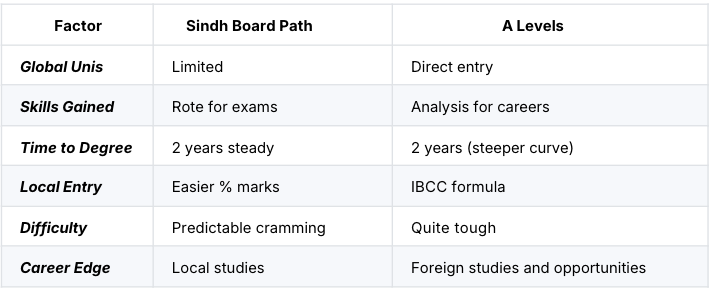
Reality: Many switchers stumble at first by trying to memorize — real progress happens when you focus on understanding and applying ideas.
Step-by-Step Switch Process If You Decide Yes
Step 1: Admin & Eligibility (Start 3–6 months early)
Requirements & Process
- Matriculation: Most colleges require around 60–70% (80%+ preferred by competitive institutions); transitioning after Class 10 is typical.
- Documents:
- Matric certificate/mark sheet from BISE Sindh
- Migration certificate (if required)
- Process:
- Enrollment in a CAIE-registered school (e.g., City School, Beaconhouse) or as a private candidate.
- Exam registration through the school or the British Council.
- IBCC equivalence later: Matriculation + A Levels
Step 2: Master Command Words
Command Words
- Command:
- Describe
- Explain
- Evaluate
What It Demands:
- Sequence/Observations
- Mechanism/Causes
- Pros/Cons + Conclusion
Step 3: Resources
- Varied Study Materials: A Levels require more than one textbook. Explore resources like of best CAIE tutors and Hodder Education textbooks for in-depth insights and practice questions.
- Use Mark Schemes: Familiarize yourself with the exam format using past papers and mark schemes to improve your answering skills.
- Online Learning Platforms: Websites like SaveMyExams offer revision notes and practice questions to reinforce your knowledge. PapaCambridge can be used as a free alternative.
- Educational Videos: Numerous YouTube channels, provide video lectures for better understanding of complex topics.
- Join Study Groups: Collaborate with peers to share resources and discuss challenging concepts.
By leveraging diverse study materials and online resources, you can smoothly transition from the Sindh Board to A Levels.
Step 4: Study Overhaul
Study Schedule Overview
- Total Time Allocation:
- 4 hours on content
- 2 hours on past papers
- 1 hour for review
- Study Structure:
- Basics
- Mocks
- Timed exams
- Mindset:
- Early failures = Normal brain rewiring
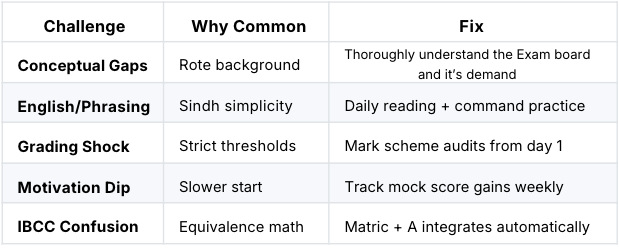
Challenges & Fixes Table
Success Path Forward
Target: Achieve A*- B Grades in 3 to 4 Subjects.
- Institutions of Interest: Local or international universities aligned with your academic goals.
- Advantage: A Levels are highly recognized by foreign universities, often strengthening international applications, while local universities evaluate them alongside other qualifications based on grades and entrance tests.
- Current Sindh Trend: The government is now implementing CAIE in public schools, making the transition more accessible
Next Step
Shifting from Sindh Board to A Levels is a big step, but with the right preparation and mindset, it can open doors to broader academic and career opportunities. Take time to understand the requirements, choose your subjects wisely, and embrace the shift toward concept-based learning, the effort you invest now will shape your future path.