Selecting your Cambridge International AS & A Level subjects is a critical strategic decision that shapes your trajectory toward higher education. These qualifications are independently verified by UK NARIC as “globally relevant and robust,” serving as a definitive “passport to success” for entry into the world’s most prestigious universities. However, many students treat subject selection as a matter of simple preference rather than a calculated step in a professional admissions process.
Your A Level strategy must be built upon the foundation of your IGCSE choices. While five Grade Cs at IGCSE or O Level (including English and Mathematics) may meet the “minimum freshman entry” for some institutions, elite global universities demand a far more rigorous selection process starting from year 11.
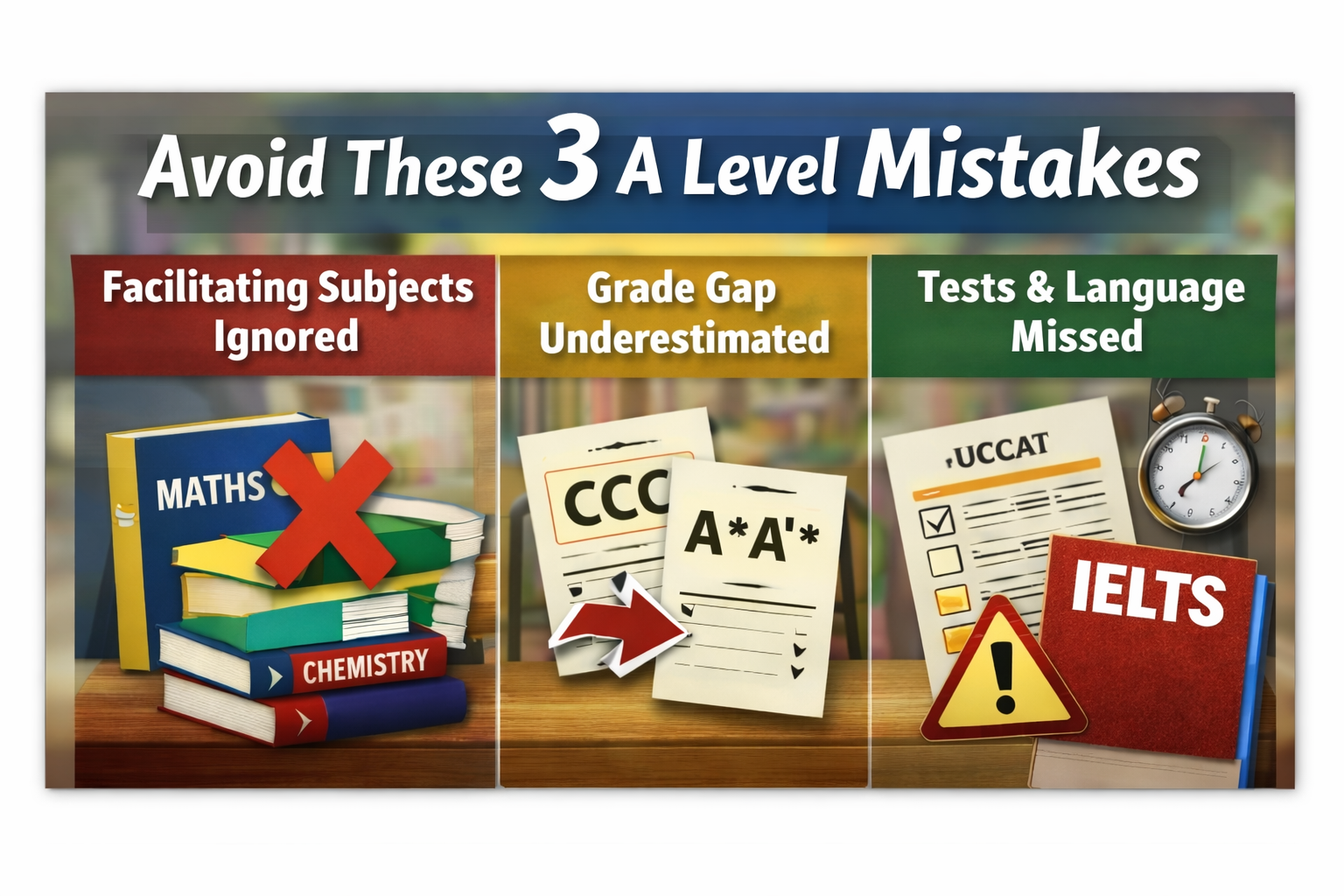
To ensure your application is competitive, you must avoid these three common strategic pitfalls.
Mistake 1: Ignoring “Facilitating Subjects” and Prerequisite Rules
Elite institutions prioritize candidates who demonstrate academic breadth through the selection of “facilitating subjects.” As defined by the Russell Group ‘Informed Choices’ guide, these are academically rigorous courses that provide a versatile foundation for a wide range of degree programs. If your profile lacks at least two of these, you risk inadvertently narrowing your future options.
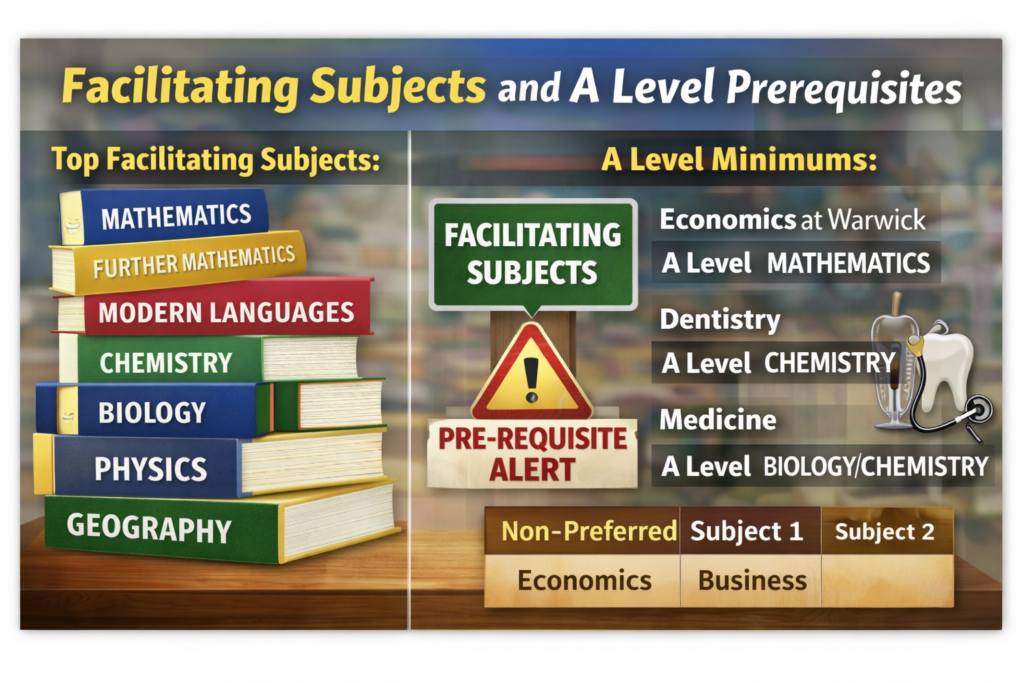
Facilitating Subjects include:
- Mathematics and Further Mathematics
- Physics, Biology, and Chemistry
- History and Geography
- English Literature
- Modern and Classical Languages
Choosing “Thinking Skills” as a core subject is a common pitfall that can result in an automatic rejection from G5 universities, as it is not always accepted as one of the three required A Levels. Furthermore, be cognizant of “non-preferred” combinations. For example, taking both Economics and Business Studies is often discouraged because the subjects are seen as overlapping in content, thereby reducing the academic breadth of your profile.
Finally, specific career paths have mandatory prerequisites that cannot be bypassed. Top-tier programs, such as Economics at the University of Warwick, mandate A Level Mathematics. Similarly, programs in Medicine, Dentistry, or Veterinary Science typically require A Level Chemistry or Biology.
Mistake 2: Underestimating the “Competitive Gap” in Grades
There is a significant distinction between meeting a university’s “floor” and being a viable applicant in a highly selective pool. A technical understanding of the admissions hierarchy is essential for a realistic strategy.
| Level | What It Means |
| Minimum Requirement | Basic eligibility to apply (e.g., BBC at McGill or BBB at some Russell Group). |
| Typical Offer | The common conditional offer made to standard applicants (e.g., AAA). |
| Competitive Profile | The grades successful applicants actually present (e.g., A*A*A). |
Consider McGill University: while the official minimum is listed as “three A Levels at BBC,” the reality is a “highly selective” process where successful applicants present A and A* grades. Furthermore, “Minimum Requirements” are often reserved for candidates receiving “Contextual Offers” (e.g., the University of Bristol reducing a standard A*AA offer to AAB based on socioeconomic factors). For standard applicants, relying on the minimum is rarely sufficient; at institutions like Harvard, Yale, or Oxford, the competitive profile is the only true benchmark.
Mistake 3: Overlooking Admissions Tests and Language Components
Grades are the bedrock of your application, but for competitive programs, they are merely the first hurdle. Many courses require specialized national admissions tests to differentiate between high-achieving candidates.
Key Admissions Tests:
- UCAT: Mandatory for Medicine and Dentistry.
- LNAT: Required for Law at many top UK and international universities.
- TMUA / ESAT: Essential for Mathematics, Science, and Engineering. Note that the ESAT has recently replaced several older subject-specific tests for entry into elite STEM programs.
Do not overlook the specificities of the English Language requirement. To satisfy university standards and Tier 4 visa safeguards, students should take IGCSE First Language English (0500) including the optional Speaking and Listening components. Proving proficiency in all four skills (Reading, Writing, Speaking, and Listening) is vital for international mobility.
For science students (Biology, Chemistry, and Physics), the practical components—Paper 3 and Paper 5—are non-negotiable. While Paper 3 (the “Wet Lab”) focuses on the manipulation of apparatus and data presentation, Paper 5 is a written examination testing “higher-order experimental skills” like planning and evaluation. As Richard Partington, Senior Tutor at Churchill College, Cambridge, notes:
“Cambridge International A Levels are an excellent technical qualification… they provide a really good bedrock for the move—the transition to university in the first year of study.”
Conclusion: How to Be an Informed Applicant
The most successful applicants begin their research 10–12 months before applications open. Because “minimum entry requirements” vary significantly by institution—and because Cambridge A Levels are linear, meaning retakes are only permitted for the whole subject—early planning is paramount.
Verify every prerequisite on individual university websites and use the Russell Group ‘Informed Choices’ guide to audit your subject combinations. Cambridge qualifications are designed to build the higher-order problem-solving and critical thinking skills that universities value most; choosing your subjects strategically ensures those skills carry you through the gates of your first-choice institution.