1. The Digital Shift in Global Assessment
The landscape of international education is reaching a transformative milestone. In 2027, Cambridge International Education will officially launch its global rollout of digital examinations. This transition is not merely a change in medium, but a strategic move to provide a seamless, intuitive exam experience that mirrors the digital workflows of modern higher education and future professional careers. As an Academic Success Specialist, I view this shift as an empowering step forward, offering learners a resilient and flexible platform designed for the 21st century.
2. What Is Cambridge Digital Exams?
Cambridge Digital Exams is a sophisticated digital alternative to traditional paper-based assessments. It is essential to understand that this is not a “watered-down” version of the curriculum; it maintains the exact same high standards, integrity, and validity as the paper exams.
The reliability of this platform is proven. Since the launch of the Digital Mocks Service in 2023, more than 23,000 digital mock exams have been sat across 60 countries. This extensive data confirms that the system is robust and ready for high-stakes assessment. Furthermore, students and parents should note that final certificates will not distinguish between digital or paper formats. Both hold equal value and are recognized identically by universities and employers worldwide.
3. Official Cambridge Timeline: The Path to 2027 and Beyond
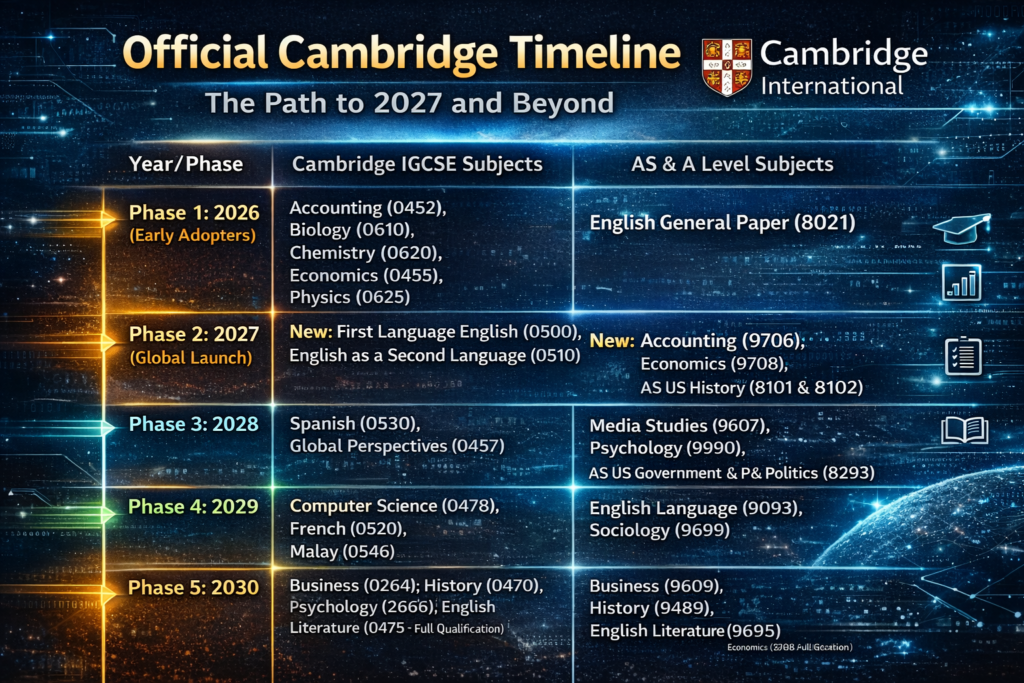
The transition follows a structured, phased rollout to allow schools and students sufficient time to adapt. Use the table below to track when your specific subjects will become available in the digital format.
Phased Rollout of Cambridge Digital Exams
| Year/Phase | Cambridge IGCSE Subjects | AS & A Level Subjects |
| Phase 1: 2026 (Early Adopters) | Accounting (0452), Biology (0610), Chemistry (0620), Economics (0455), Physics (0625) | English General Paper (8021) |
| Phase 2: 2027 (Global Launch) | New: First Language English (0500), English as a Second Language (0510) | New: Accounting (9706), Economics (9708), AS US History (8101 & 8102) |
| Phase 3: 2028 | Spanish (0530), Global Perspectives (0457) | Media Studies (9607), Psychology (9990), Global Perspectives (9239), AS US Government & Politics (8293) |
| Phase 4: 2029 | Computer Science (0478), French (0520), Malay (0546) | English Language (9093), Sociology (9699) |
| Phase 5: 2030 | Business (0264), History (0470), Psychology (0266), English Literature (0475), Economics (0455 – Full Qualification) | Business (9609), History (9489), English Literature (9695), Economics (9708 – Full Qualification) |
4. On-Screen Exams: What Students Will Experience
Digital exams are delivered through the RM Assessment Master platform, accessed via the Safe Exam Browser or Google Kiosk mode. This setup ensures a high-security “lockdown” environment where candidates cannot access external websites or files.
Practical Logistics: Logins and Resilience
- Unique Credentials: For a given exam series, you will receive a single, consistent username. However, you will be issued a different password for every individual exam to ensure security.
- Offline Resilience: A major concern for many is the “what if” of internet failure. In 2027, the platform features robust offline resilience. If the connection drops, you continue working uninterrupted. Your answers are saved locally on your device and automatically uploaded once the connection is restored.
Built-in Student Tools & Accessibility The platform includes an accessibility panel allowing you to personalize your environment:
- Navigation & Planning: Highlighter tool for stimulus text and a digital notepad for drafting.
- Visual Adjustments: Zooming capabilities, adjustable background colors, and font/line height settings for essay responses.
- Multimedia Support: Adjustable volume, closed captioning, and video transcripts for components involving audio or video.
- Student Well-being: The system supports candidate rest breaks. Invigilators can pause and resume the exam clock for approved breaks, provided you do not submit your work until the very end of your session.
5. Format & Workflow Differences
While the syllabus content remains identical to paper exams, the interaction methods are optimized for a digital interface.
| Question Type | Digital Interaction Method |
| Multiple Choice (MCQs) | Selecting answers via circular/radio buttons or drag-and-drop functionality. |
| Longer Response | Typing into text boxes with formatting tools (bold, italic, bullets). |
| Resources/Extracts | Side-by-side display where stimulus material and the response area are visible simultaneously. |
Expert Tip: You can drag and adjust the size of the stimulus and response areas on your screen to create your most efficient workspace.
6. Digital Marking & Assessment Changes
Cambridge utilizes a dual marking system: Multiple Choice Questions (MCQs) are auto-marked by the platform for speed and accuracy, while non-MCQ responses and essays are marked by expert Cambridge examiners.
The marking standards and schemes are identical to paper exams. However, the digital format offers a superior advantage for preparation: the Digital Mocks Service. This service provides question-level marks. I strongly advise students to use this data to identify specific syllabus gaps. Instead of general revision, you can see exactly which topics require further mastery based on precise performance metrics.
7. Why Typing Speed & Accuracy Matter
As an expert, I must emphasize that spellcheck is disabled in the exam platform. Spelling, punctuation, and grammar will be assessed only if the specific syllabus marking criteria requires it.
However, typing speed is a functional necessity. If you are a slow typist, you may struggle to complete the paper. While extra time can be provided for those with genuine typing difficulties, this is not automatic; it requires a formal application process through your school’s Exams Officer. You should prioritize typing practice now to ensure your technology skills do not hinder your academic expression.
8. Tech & Device Readiness
Schools can use school-owned hardware or allow students to bring their own devices, provided they meet these minimum requirements:
Minimum Hardware & Software Requirements
| Device Type | Operating System Version | Processor | RAM |
| Windows | Windows 10 or 11 | Intel i3 or equivalent | 4GB |
| Mac | Version 13 or 14 | Intel i3 or equivalent | 4GB |
| Chromebook | Latest OS (Managed) | Quad-core | 4GB |
Key Checklists:
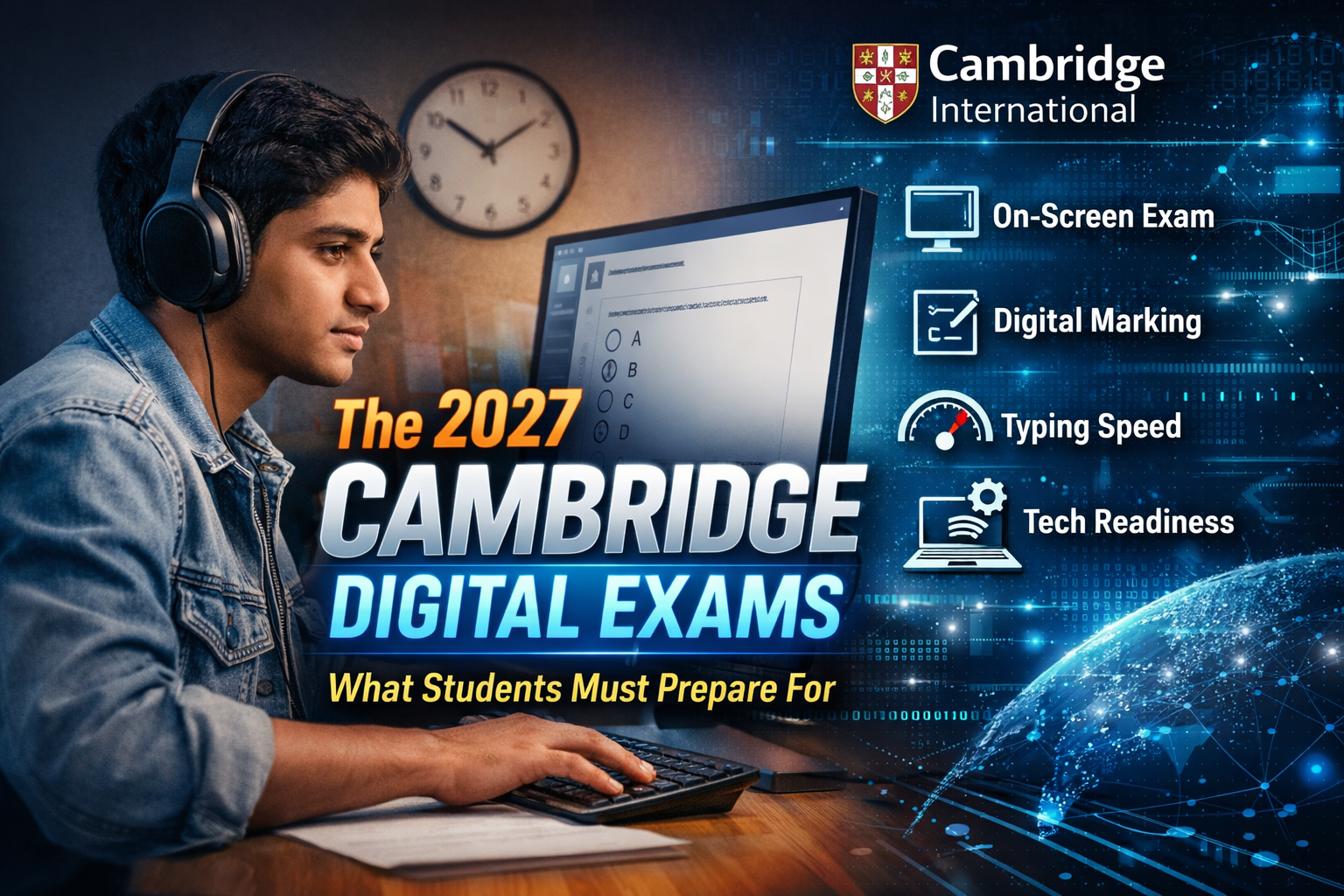
- Peripherals: You must have a keyboard and a mouse or trackpad. Headphones are mandatory for listening components.
- Self-Testing: Use the device and bandwidth checkers available in the Cambridge supporting documents to verify your laptop is ready before exam day.
9. How Students Should Prepare: Practical Tips
Success in 2027 requires more than just subject knowledge; it requires “digital fluency.” Follow these steps:
- Use the Digital Mocks Service: This is the most effective way to gain a “like-for-like” experience of the final exam environment.
- Engage with Demonstration Tests: Every syllabus has specific demo tests. Use these to understand how your specific subject’s questions (like drag-and-drop or essay boxes) function.
- Practice with Familiarisation Materials: Experiment with the accessibility panel early. Find the background color and font size that reduces your eye strain and improves your focus.
- Master the Navigation: Practice logging in with different passwords and navigating the Safe Exam Browser. On exam day, the technology should feel invisible, allowing you to focus entirely on your answers.
10. Why This Matters for 2027 Students
The 2027 cohort is at the forefront of a global shift toward more flexible and relevant assessment. This transition is ultimately about choice; it empowers your school to offer the format—digital or paper—that best aligns with your strengths.The move to digital is a milestone in your academic journey. To ensure you are fully prepared, I recommend speaking with your school’s Exams Officer as soon as possible about participating in the next Digital Mocks series, starting in July 2026. Early exposure is the best predictor of success.