Imagine a secret key to academic success—past papers are just that! They transform your knowledge into exam-ready skills, boosting grades by revealing patterns, timing challenges, and examiner expectations. Explore this guide filled with strategies for tackling past papers efficiently. Discover phases tailored for various timelines, ensuring students can use these techniques whether exams are imminent or still a while away.
Why Solving Past Papers Works
Core Principles Before Starting
- Utilize official Cambridge papers from the last 10 to 15 years, along with mark schemes and examiner reports.
- Always complete the solutions first before marking—no peeking in between!
- Keep track of everything: scores, errors, and patterns.
Unlike passive reading, working through past papers fosters active recall, mimics exam pressure, and familiarizes students with the marking scheme language—essential for mastering O Levels and diving deep into A Levels. Students who tackle these papers systematically experience significant improvements, particularly during the transition from O Levels to A Levels, where analytical skills become increasingly important.
Step 1: Identify Missed Keywords and Phrasing
- Take note of any missed keywords or phrases (e.g., “covalent bond” versus “sharing electrons”).
- Correct any errors without relying on notes the following day.
Study Time Per Session
- Allocate 1 to 2 hours per topic.
- Repeat this process until you achieve at least 90% accuracy.
Focused Learning Approach
- Tackle one topic at a time to identify repetitions and gaps in knowledge.
- Choose a specific chapter (e.g., O Level Algebra or A Level Organic Chemistry).
- Collect 8 to 10 years of questions solely related to that topic (using topical workbooks or online compilations).
Initial Problem-Solving Strategy
- Start solving questions without a time limit:
- Read each question twice.
- Plan your answer (outline your essays).
- Write out the full response as you would in an exam.
- Immediately cross-check your answers with the marking scheme:
- Tick off the points you’ve earned.
Goal
- Progress through these phases for each subject, repeating as necessary. Each step focuses on mastering problem-solving techniques rather than sheer volume.
Step 2 Open-Book Full Paper Solving Learn Exam Language)
- Select a Complete Yearly Paper
- Prepare Your Workspace
- Sit with your notes and textbook open.
- Solve Without a Timer:
- Attempt every question in full.
- If you find yourself stuck for 2 minutes, reference your notes, but be sure to rewrite the information in your own words.
- Strive to mimic the neatness expected in an exam.
- Mark Ruthlessly:
- Compare your phrasing precisely.
- Highlight any keywords from the marking scheme that you may have omitted.
- Rewrite 2 to 3 Low-Mark Answers Perfectly.
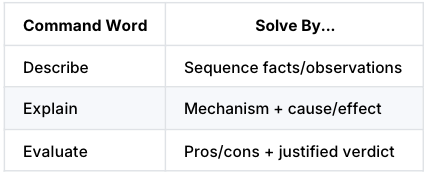
Pro Tip: Practice understanding “command words,” such as:
- State (fact)
- Explain (reason)
- Evaluate (judged balance).
Step 3 Timed Simulation Solving Build Speed & Stamina)
- Exam Duration: Add an additional hour for auditing.
- Setup:
- Create a quiet environment.
- Set a timer for the exam duration minus 10 minutes.
- Avoid using any aids.
Solve as if in a Live Exam:
- Initial Scan: Spend the first 5 minutes scanning the entire paper.
- Focus on Strengths: Start with questions that play to your strengths to build momentum.
- Time Allocation: Assign time per question (e.g., 1 minute per mark).
- Flagging Questions: Skip any stalls and return to them later.
Goals to Check:
- Did you exceed the time limit?
- Were any keywords overlooked?
- Are there any incomplete answers?
- Were there neatness issues?
Areas for Improvement:
- Prioritize strategies for the next attempt.
- Keep a log for future review.
- Practice your skipping strategy.
- Use a ruler for diagrams.
Step 4 Mistake Log & Targeted Re-Solving Lock in Gains
Objective: Eliminate recurring errors.
Maintain a Subject Notebook:
- Log: Record the question reference, your response, the correct answer, and the type of error (e.g., “misinterpreted ‘compare’ as ‘describe'”).
- Categorize: Identify the error type as a concept gap, careless mistake, or timing issue.
Weekly Ritual:
- Re-solve only the questions in your log (without timing).
- If you get it wrong again, revisit your syllabus and notes.
- Test yourself on the question in the next full exam paper.
Example:
- Q: Oct/Nov 2023 P4 Q2 Bio: Explain osmosis.
- Error: Explained diffusion instead.
- Fix: Review the mechanism; repeat the process three times
Subject-Specific Solving Hacks
Mathematics:
- Show every step to earn method marks.
- Double-check units and signs after solving.
Sciences:
- Draw and label diagrams accurately.
- Focus on practicals, including method, errors, and improvements.
Economics/Business:
- Structure your responses using the PEEL format: Point, Explain, Evidence, Link.
- Balance data with diagrams for clarity.
Humanities:
- Time your essays effectively, ensuring a clear introduction, body, and conclusion.
- Use past introductions as templates for consistency.
Languages:
- Practice regularly to improve fluency and comprehension.
- Engage with native materials like books, films, and conversations to enhance vocabulary and understanding.
Pitfalls & Instant Fixes
Strategies for Effective Learning
- Avoid premature conclusions: Allow for a two-minute thinking period before responding.
- Neglecting review: Consistently audit and log your progress.
- Hasty phrasing: Aim to rewrite one or two answers per paper with precision.
Focus on One Subject Today (if you have plenty of time in CAIE’s)
- Begin with Step 1 for your weakest topic.
- Monitor your weekly score improvements—this approach will help you reach your targets more swiftly than before.