O & A Levels mark different phases of Cambridge International Education, which is commonly embraced in Pakistan as an alternative to the Matriculation and Intermediate systems. This article outlines the key differences between the two to assist students and parents in making well-informed choices.
Educational Progression by Age
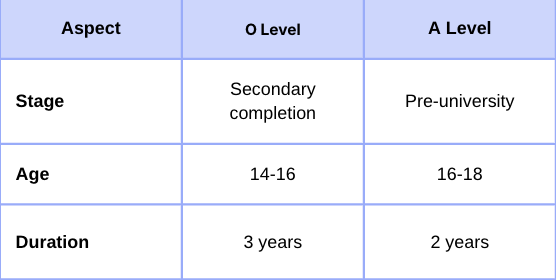
O Levels complete secondary education at average ages of 14-16, building broad foundational skills across multiple subjects. A Levels follow at ages 16-18, focusing on deep specialization to prepare students for university-level study.
Subject Structure
O LEVELS (Broad Foundation)
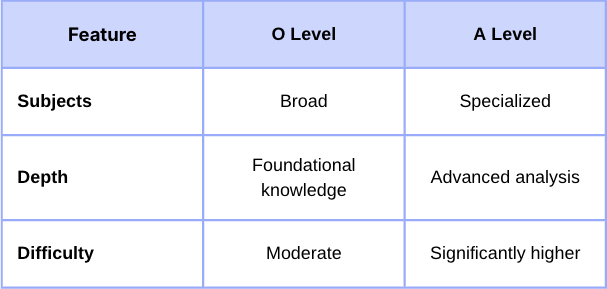
- Minimum 8 subjects
- 5 compulsory + 3 electives
- Examples: English, Math, Sciences, Languages, Humanities, Business Studies etc
A LEVELS (Deep Specialization)
- Minimum 3 subjects
- Chosen based on career goals
- Examples: Physics/Chemistry/Biology (Medicine), Physics/Chemistry/Maths (Engineering) etc
Academic Focus
Grading System
Both systems utilize the same scale:
- A* (highest) to E (minimum passing grade)
- UG = Ungraded/Fail
Key Difference:
The grade boundaries for A Levels are more stringent.
University Pathway Impact
After O Levels:
Eligible for A Levels or local Intermediate.
After A Levels:
Students can apply directly to Bachelors programs at leading universities by meeting academic criteria and passing their admission tests. Those pursuing medicine must qualify through MDCAT, while applicants to international universities often enhance their profiles through standardized tests like the SAT.

The Simple Truth
You don’t choose between O Level vs A Level.
- You do BOTH in sequence.
- Complete O Levels first (age around 14-16)
- Then specialize in A Levels (age 16-18)
- O Levels give you options. A Levels give you excellence.
Every student’s path is unique, choose the route that supports your strengths, stay curious, and keep moving forward with confidence.