
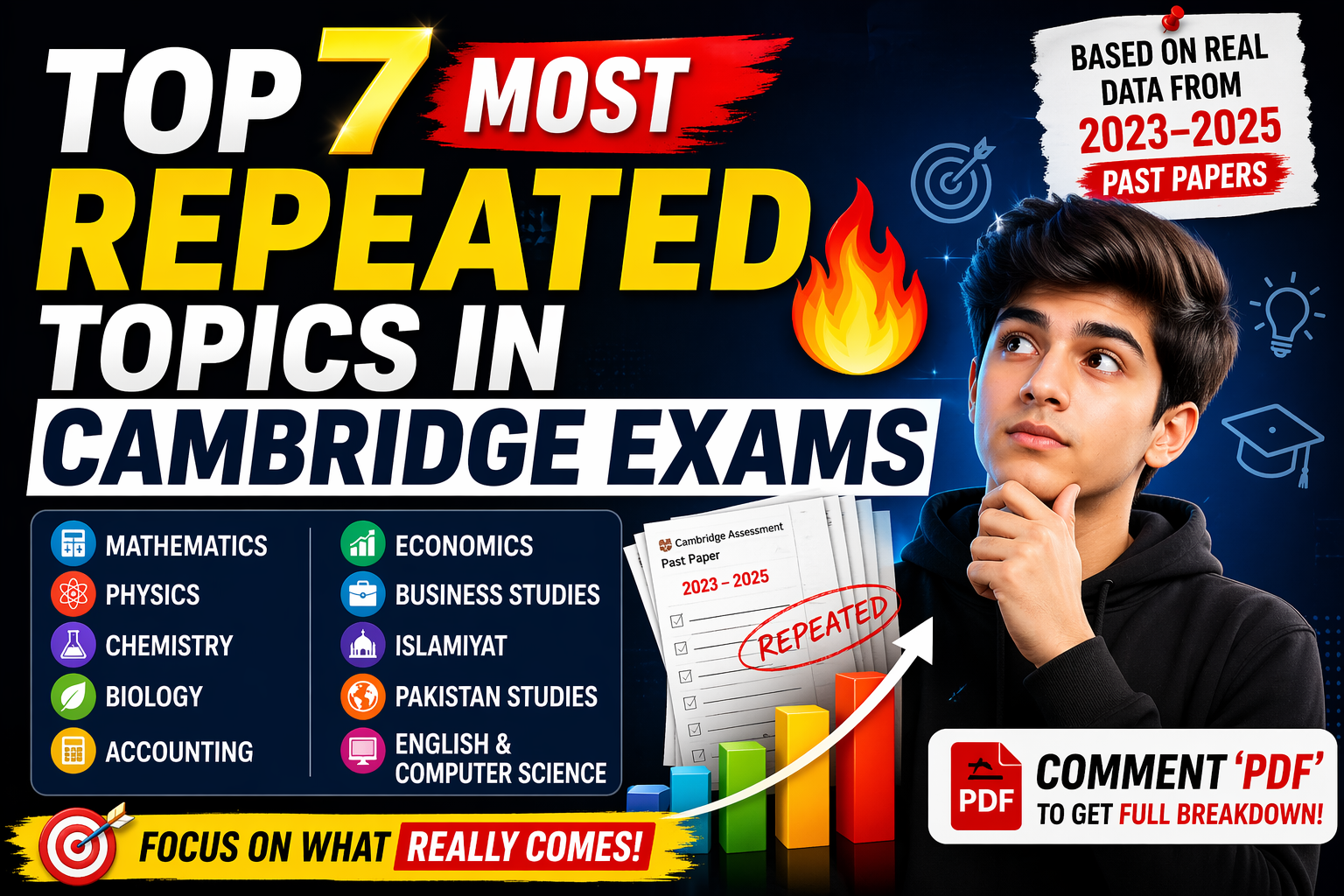
Based on Real Data from 2023–2025 Past Papers
The Real Secret to A Students*
Most students preparing for exams don’t realise that the most repeated topics in Cambridge exams are the key to scoring A. Instead of studying everything, focusing on high-frequency topics can dramatically improve your results.
This guide is based on real past paper data (2023–2025).
As a result, it highlights exactly what comes again and again.
👉 Therefore, if you focus on these topics, you study smarter, not harder.
👉 In other words, effort matters — but direction matters more.
Mathematics (4024) – Most Repeated Topics in Cambridge Exams
Here are 7 of the most repeated topics in Cambridge exams for O Level Mathematics
Top 7 Most Repeated Topics
- Algebra & Graphs → equations, factorisation, sequences
- Number → percentages, standard form, financial maths
- Statistics → histograms, cumulative frequency, scatter graphs
- Geometry → circle theorems, angles, similarity
- Mensuration → area, volume, surface area
- Probability → tree diagrams, Venn diagrams
- Trigonometry → sine/cosine rule, bearings
What This Means for You
- Algebra, Number, and Statistics appear in every paper
- Therefore, these three topics control a huge portion of marks
- As a result, weakness here leads to an instant grade drop
- More importantly, mastering them gives you a strong scoring base
Physics (5054): High-Weight Topics
Top 7 Most Repeated Topics
- Electricity & Magnetism (~112 times)
- Waves & Light (~100 times)
- Forces (~96 times)
- Thermal Physics (~84 times)
- Motion (~56 times)
- Nuclear Physics (~48 times)
- Energy, Work & Power (~42 times)
What This Means for You
- Electricity and Waves are the highest scoring areas
- In addition, practical questions often repeat (cooling, circuits, springs)
- Therefore, ignoring experiments is a major mistake
- At the same time, understanding concepts helps in both theory and MCQs
Chemistry (5070): Most Repeated Topics in Cambridge Exams
Top 7 Most Repeated Topics
- Experimental Techniques
- Stoichiometry
- Acids, Bases & Salts
- Chemical Reactions
- Organic Chemistry (~30 times)
- Atoms & Bonding (24 times)
- Metals (24 times)
What This Means for You
- Four topics appear in every paper
- As a result, mastering them gives you maximum control
- Furthermore, these topics appear in MCQs, theory, AND practicals
- Therefore, they should be your top priority
Biology (5090): Most Repeated Topics in Cambridge Exams
Top 7 Most Repeated Topics
- Ecology & Environment
- Coordination & Response
- Reproduction & Cell Division
- Movement in/out of Cells
- Enzymes
- Nutrition
- Transport in Plants & Humans
What This Means for You
- Ecology appears across all paper types
- Most importantly, osmosis and enzymes are practical favorites
- In other words, the same concepts are tested in different ways
- Therefore, understanding concepts is more important than memorising
Accounting (7707): Predictable Structure
Top 7 Most Repeated Topics
- Ratios (24/24 papers)
- Correction of Errors (24/24)
- Cash Books & Journals (24/24)
- Control Accounts (23/24)
- Depreciation (22/24)
- Partnership Accounts (21/24)
- Company Accounts (20/24)
What This Means for You
- Paper structure is almost identical every year
- Therefore, Question 1 becomes an easy scoring opportunity
- In addition, financial statements offer high marks
- As a result, preparation here gives predictable results
Economics (2281): Most Repeated Topics in Cambridge Exams
Top 7 Most Repeated Topics
- Demand & Supply (every paper)
- Unemployment
- Government Policies
- Economic Growth (GDP)
- Balance of Payments
- Firms & Costs
- Inflation
What This Means for You
- Learn diagrams and definitions properly
- As a result, you will handle most questions easily
- Furthermore, concepts repeat with different case studies
- Therefore, practice applying knowledge in context
Business Studies (7115): Case Study Patterns
Top 7 Most Repeated Topics
- Marketing Mix
- Business Finance
- Recruitment & Training
- Break-even & Costs
- Business Growth
- Business Organisation
- International Trade
What This Means for You
- Focus on “justify” and “recommend” answers
- In fact, the same logic is tested every year
- Therefore, structured answers are essential
- At the same time, clarity of explanation improves marks
Islamiyat (2058): Fixed Structure
Top 7 Most Repeated Topics
- Qur’an Themes
- Hadith Teachings
- History of Qur’an
- History of Hadith
- Rightly Guided Caliphs
- Pillars & Articles of Faith
- Life of Prophet (PBUH)
What This Means for You
- You cannot skip any topic
- Therefore, full coverage is necessary
- Otherwise, you risk losing guaranteed marks
- In addition, structured answers improve scoring
Pakistan Studies (2059)
Paper 1: History
- Pakistan Movement
- Constitutional Development
- Key Leaders
- 1857 War
- Foreign Relations
Paper 2: Geography
- Agriculture
- Water Resources
- Energy
- Population
- Industry
- Climate
- Transport
What This Means for You
- Questions rotate each year
- However, the core topics remain the same
- Therefore, consistent revision is key
English (1123): Skill-Based Paper
Top 7 Components
- Comprehension
- Summary Writing
- Writer’s Effect
- Directed Writing
- Narrative Writing
- Descriptive Writing
- Argumentative Writing
What This Means for You
- Format never changes
- Therefore, consistent practice leads to improvement
- In other words, skills matter more than memorisation
Computer Science (2210): Logic-Based
Top 7 Most Repeated Topics
- Algorithms (53 times)
- Programming (49 times)
- Hardware (42 times)
- Internet & Security (30 times)
- Data Representation (23 times)
- Data Transmission (18 times)
- Databases (12 times)
What This Means for You
- Algorithms and Programming carry the most marks
- Most importantly, Databases appear in every paper
- As a result, they are easy scoring opportunities
- Therefore, focus on logic and practice
Key Exam Patterns You Must Know
- Most repeated topics in Cambridge exams every year
- Moreover, Paper 2 carries higher complexity and marks
- Many questions combine multiple topics
- In fact, some topics appear in every paper
- Overall, exams are predictable — not random
Smart Study Strategy
- Focus on high-frequency topics first
- Then, move to less frequent areas
- Use past papers instead of only notes
- Additionally, practice practical questions regularly
- Also, Learn how to attempt past papers effectively
- Finally, learn how to answer, not just content



2 Comments
Noah Acha
May 16, 2026can u make one for CAIE As & Alevels pls
common subjects are, Mathematics, Economics, Information technology, computer sciences, biology, chemistry, physics, business studies
Teachwink Team
May 16, 2026We have done that for AS Level, please check this link – https://teachwink.com/a-level-exam-topics-2026/