
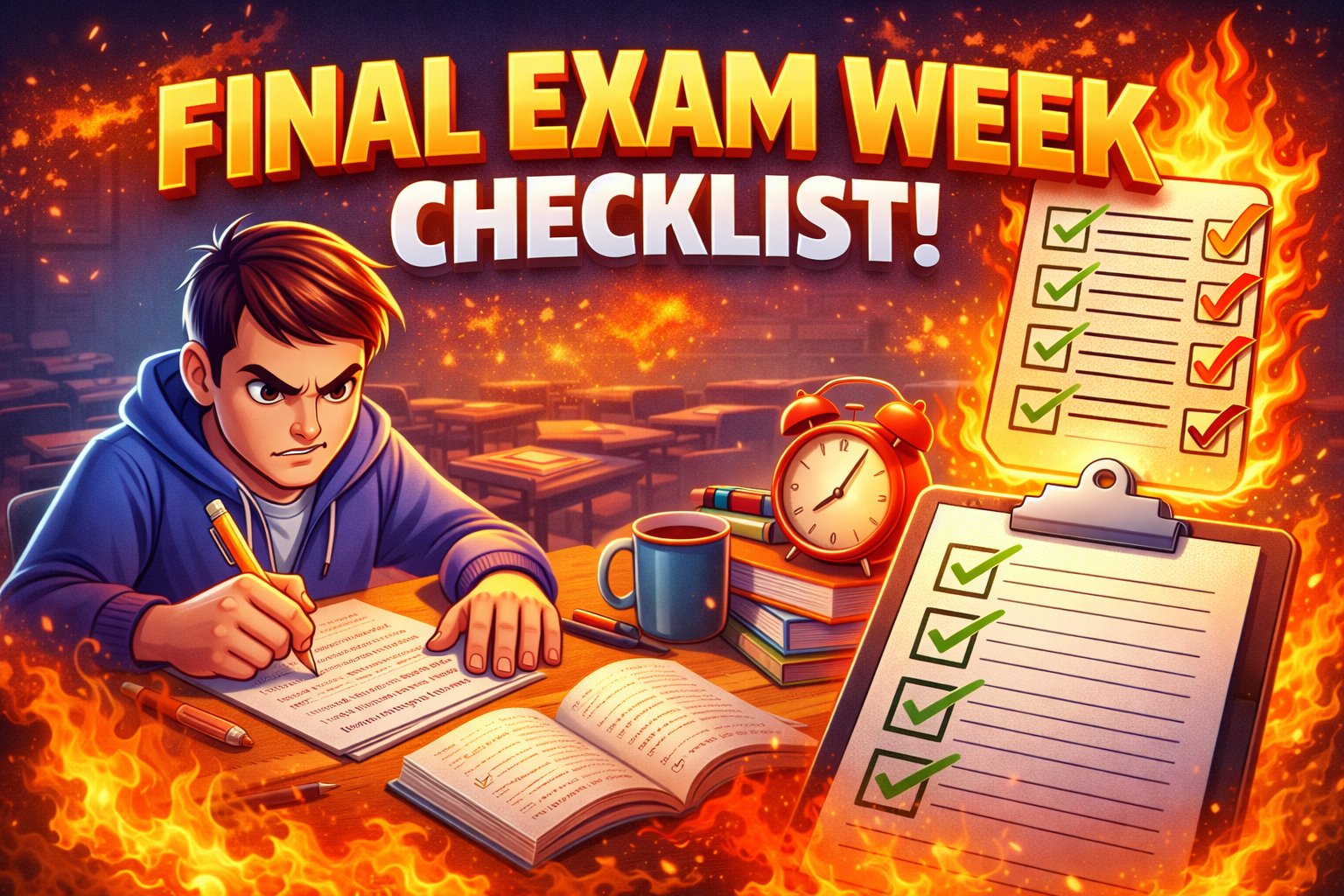
Shifting from Random Tasks to a Closed-Loop System
Peak performance is a byproduct of architecture, not luck. Most students fail because they fall into the trap of “random studying”—passively flipping through notes and hoping for the best. To dominate your finals, you must scrap the disorganized tasks and adopt a closed-loop system.
This is your Elite Execution Sheet. This system is designed to ensure that no mistake is left uncorrected and no weakness remains hidden. We are shifting from “doing work” to “executing a system” that tells you exactly where you stand.
——————————————————————————–
Method 1: The Daily Execution Block (The Core Routine) 🧠
To achieve elite results, you must move away from random tasks and adopt a fixed, high-intensity routine. This three-part block creates a closed-loop system—a competitive differentiator that most students simply do not have.
Morning / First Session: The Benchmark
- [ ] Full Timed Past Paper: Complete a paper under strict, exam-room conditions. No phones, no snacks, no pauses.
- [ ] Mark Immediately: Delaying feedback kills the learning curve. Mark your work the second the timer hits zero.
Mid Session: Deep Error Analysis
- [ ] Categorize Every Mistake: Do not just look at the mark scheme. You must diagnose why the mark was lost:
- Concept Issue: You didn’t know the material. The Fix: Re-learn the core theory.
- Careless Error: You knew it but slipped up. The Fix: Create a pre-flight checklist to catch these.
- Time Issue: You couldn’t finish. The Fix: Practice speed-drills on high-yield sections.
Final Session: Targeted Practice
- [ ] Close the Loop: Solve 10–15 focused questions exclusively on the weak areas identified in the morning paper. 👉 This step is vital; it ensures you never make the same mistake twice.
——————————————————————————–
Method 2: The Paper Performance Tracker (Visualizing Patterns) 📊
Stop guessing your readiness. Performance is data. Use this tracker to force yourself to see objective patterns rather than relying on a “feeling.”
| Paper | Score | Time Left | Mistakes Type | Weak Topic | Pattern Identified |
👉 Instruction: Update this table after every session. If the same topic appears in the “Weak Topic” column twice, it is a red alert that requires immediate intervention.
——————————————————————————–
Method 3: The Mistake Conversion System (Turning Mistakes into Marks) ❌
Simply reading a correction is useless. This system is rarely taught, but it is the fastest way to bridge the gap between a B and an A*. Apply this to every error:
- [ ] Rewrite the full solution from scratch: Close the mark scheme and reproduce the perfect answer from a blank page.
- [ ] Write a Justification: State exactly why the mistake occurred (e.g., “I ignored the ‘not’ in the question”).
- [ ] Solve a similar question immediately: Prove you have actually learned the correction.
- [ ] Schedule a 48-Hour Re-test: Set a hard reminder to solve this specific question type again in two days to ensure memory lock-in.
——————————————————————————–
Method 4: The High-Yield Revision Filter (Strategic Triage) 📚
In the final 72 hours, your time is a finite resource. You cannot revise everything. You must perform strategic triage to maximize your economy of time.
- [ ] Focus exclusively on frequent topics: If it appears in 80% of past papers, it deserves 80% of your time.
- [ ] Skip low-frequency/rare topics: If a topic appears once every five years, it is dead weight. Cut it.
- [ ] Prioritize “Mark-Loss” areas: Stop practicing what you are already good at. Lean into the topics where you are consistently losing marks. 👉 This saves 10+ hours of wasted effort.
——————————————————————————–
Method 5: Memory Lock-In (Active Recall Strategy) 🧠
Passive revision (rereading or highlighting) is an illusion of competence. Use Active Recall to ensure information is accessible under pressure.
- [ ] Formula Dump: Write every key formula from memory on a blank sheet.
- [ ] The Teacher Test: Teach a complex concept out loud. If you stumble, your understanding is shallow.
- [ ] High-Difficulty Recall: Solve 2–3 of the hardest questions in the syllabus WITHOUT referring to any notes.
——————————————————————————–
Method 6: The Exam Simulation Check (The A* Differentiator) ⏱
What separates an A from an A* is the ability to fire on all cylinders at the exact moment of the exam.
- [ ] Sync with the Clock: Conduct your simulation at the exact hour your real exam begins. Train your brain to be at peak alertness during that window.
- [ ] Zero-Distraction Environment: No music, no phone, no family.
- [ ] Physical Presentation: Practice the “admin” of the exam—bubbling answers or formatting essay headers—to eliminate any friction on the day.
——————————————————————————–
The Final Week Non-Negotiables 🚫
Discipline is defined by what you refuse to do. Observe these boundaries strictly:
- [ ] NO new topics: Unless it’s a high-yield emergency, refine what you know.
- [ ] NO passive watching: If you aren’t writing or solving, you aren’t studying.
- [ ] NO random studying: If it’s not in the Daily Execution Block, don’t touch it.
- [ ] NO ignoring weak areas: Facing your errors is uncomfortable, but it’s where the marks are.
——————————————————————————–
Final Readiness Score: How Prepared Are You? 🎯
Be brutally honest. Tick the boxes that are 100% true for you right now:
- [ ] I consistently finish papers with time to spare.
- [ ] My scores are reliably above my target grade.
- [ ] I rarely repeat a mistake once I’ve analyzed it.
- [ ] I can solve my “weak topics” without any external prompts.
Your Score: ____ / 4
Interpretation:
- 4/4: ELITE STATUS. You are ready for execution.
- 2–3: GAPS DETECTED. Re-read Method 3 and fix the leakages NOW.
- 0–1: EMERGENCY STATUS. Your current system has failed. Re-read Method 1 and restart the closed-loop system immediately.
——————————————————————————–
Executing the Plan
Success is not a feeling; it is a result of following a high-performance system with absolute discipline. This Execution Sheet is your roadmap. Your job is simple: follow the Block, track the data, and convert every mistake into a mark.
Now, get to work. Execute the plan.





2 Comments
Zainab
April 20, 2026Awesome checklist. I’ve watched other of your reels and Instagram posts, you have helped me a lot man. Thanks💗✌🏼
Teachwink Team
April 21, 2026Thank you for the kind words, happy to help