Strategic Revision for A Level Exam Success
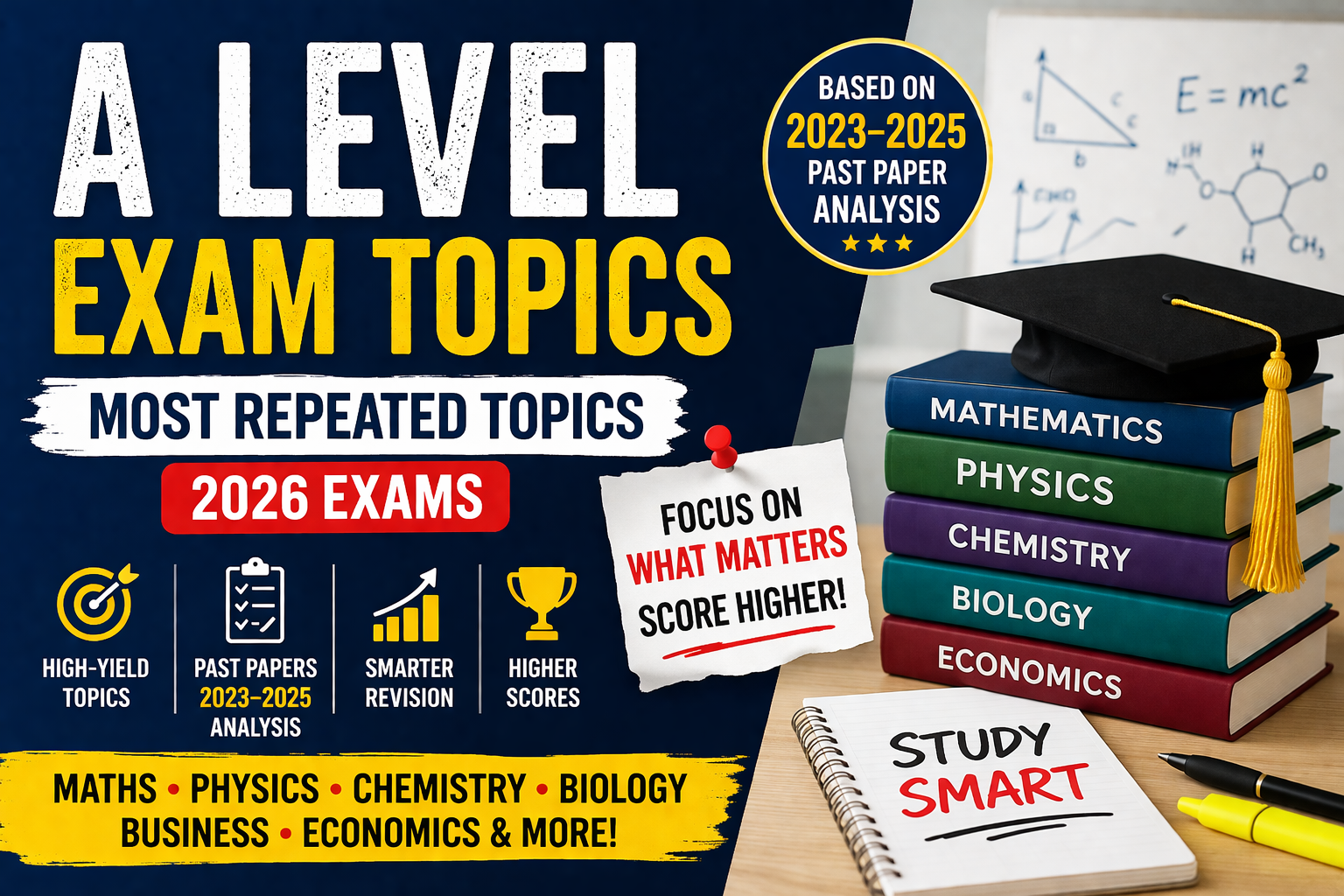
A Level exam topics can feel overwhelming because every subject has a large syllabus. However, past paper analysis from 2023–2025 shows that Cambridge examiners repeat certain topics more often than others. Therefore, this guide highlights the most repeated A Level exam topics so students can revise smarter, focus on high-yield areas, and secure more marks in less time.
Consequently, mastering these high-frequency areas not only improves efficiency but also builds confidence. For example, when you walk into the exam already familiar with common question patterns, you gain momentum immediately.
Most Repeated A Level Exam Topics Based on Past Papers
When you break down past papers, you begin to notice that some A Level exam topics dominate entire sections of the exam. These are the areas where most marks are concentrated. As a result, focusing your revision around these topics can significantly improve both speed and accuracy under exam conditions.
A Level Exam Topics in Mathematics (9709)
Paper 1: Pure Mathematics 1
Series (~45 occurrences)
Firstly, this is the most important topic. You must master:
- Binomial expansion
- Arithmetic vs Geometric Progressions
As a result, nearly every paper includes multiple questions from this area.
Differentiation (~40 occurrences)
Additionally, strong skills in:
- Stationary points
- Tangents and normals
- Rates of change
are essential.
Integration (~35 occurrences)
Furthermore, expect questions on:
- Area under curves
- Volume of revolution
Trigonometry (~35 occurrences)
Similarly, you must:
- Prove identities
- Solve equations within intervals
Functions (~30 occurrences)
Finally, focus on:
- Range
- Composite & inverse functions
- Transformations
Paper 4: Mechanics
Energy, Work & Power (~35 occurrences)
To begin with, this is a core area. Therefore, master:
- Work done
- Power formula (P = Fv)
- Energy conservation
Kinematics (~30 occurrences)
Moreover, you must:
- Interpret velocity-time graphs
- Apply calculus relationships
Newton’s Laws (~22 occurrences)
In addition, focus on:
- Inclined planes
- Connected particles
Forces & Equilibrium (~20 occurrences)
At the same time, ensure you can:
- Resolve forces
- Handle friction problems
Momentum (~15 occurrences)
Lastly, understand:
- Conservation of momentum
- Collisions
Paper 5: Probability & Statistics
Discrete Random Variables (~40 occurrences)
Most importantly, you must confidently calculate:
- Expectation E(X)
- Variance Var(X)
Normal Distribution (~35 occurrences)
Furthermore, this includes:
- Z-scores
- Continuity correction
Permutations & Combinations (~30 occurrences)
In addition, focus on:
- Arrangements
- Restrictions
Data Representation (~28 occurrences)
Likewise, practice:
- Histograms
- Box plots
Probability (~22 occurrences)
Finally, master:
- Tree diagrams
- Conditional probability
These A Level exam topics should be your first revision priority. However, students should not ignore the full syllabus because Cambridge can still test less common areas.
A Level Exam Topics in Physics (9702)
Paper 1: Multiple Choice
To begin with, each paper follows a predictable structure. For instance:
- Waves (~10 questions per paper)
- Kinematics & Dynamics (~8 questions)
- Electricity (~8 questions)
- Units (first questions)
- Particle Physics (last questions)
Paper 2: Structured Questions
Similarly, every paper typically includes:
- Particle Physics (final question)
- D.C Circuits
- Dynamics
- Waves
- Deformation of solids
Paper 3: Practical Skills
Importantly, practical papers always assess:
- Uncertainty & measurements
- Kinematics experiments
- Circuits
- Forces
- Material deformation
Similarly, these A Level exam topics in Physics are repeated across multiple exam variants. As a result, focusing on these A Level exam topics gives you a strong advantage in the exam.
A Level Exam Topics in Chemistry (9701)
Paper 1
- Stoichiometry (100% appearance)
- Periodic trends
- Bonding
- Atomic structure
- Organic basics
Paper 2
Additionally, focus on:
- Periodicity (Period 3 reactions)
- Organic synthesis
- Stoichiometry calculations
- Energetics (Hess cycles)
Paper 3
Most importantly:
- Titrations (every paper)
- Qualitative analysis
- Gas volume / gravimetric
- Enthalpy experiments
In addition, these A Level exam topics form the core of most structured questions. Consequently, ignoring these can lead to unnecessary loss of marks.
A Level Exam Topics in Biology (9700)
Paper 1
Typically:
- Cell structure (first questions)
- Biological molecules
- Transport systems
- Immunity (last questions)
Paper 2
Every paper includes:
- Transport in mammals
- Cell structure identification
- Immunity
- Biological molecules
Paper 3
Always tested:
- Microscopy drawing
- Enzymes
- Osmosis experiments
- Biochemical tests
Accounts (9706): Key Exam Areas
Paper 1
- Reconciliation
- Costing
- Financial statements
- Depreciation
- Ratios
Paper 2
Notably:
- Financial statements (30 marks guaranteed)
- Costing (30 marks guaranteed)
- Ratio analysis
- Partnerships
Economics (9708): Most Repeated Topics
Paper 1
- Macroeconomics (highest weightage)
- Demand & Supply
- Trade
- Government policies
Paper 2
Consistently tested:
- Inflation
- Elasticity
- Market failure
- Trade policies
Business (9609): Core Concepts
Paper 1
- Marketing
- HRM
- Finance sources
- Business structures
- Motivation
Paper 2
Additionally:
- Break-even & costs
- Marketing strategy
- Operations
- HRM applications
Computer Science (9618): Key Focus Areas
Paper 1
- Databases
- Processor cycle
- Logic gates
- Ethics
- Data representation
Paper 2
Most importantly:
- Programming logic
- Data structures
- ADTs
- Testing
- Algorithms
Psychology (9990): Must-Know Studies
- Bandura (100% appearance)
- Milgram
- Piliavin
- Andrade
- Saavedra
Sociology (9699): Core Themes
Paper 1
- Identity
- Research methods
- Positivism vs Interpretivism
- Social control
Paper 2
- Family diversity
- Perspectives
- Gender roles
- Social policy
Final Exam Strategy (High Impact)
While high-frequency topics secure your base marks, top grades require more. However, relying only on common topics is not enough. The goal is not to predict the exam perfectly, but to use repeated A Level exam topics as a smarter revision guide.
Therefore, follow this strategy:
1. Prioritize Guaranteed Topics
Firstly, start with topics that appear every year.
2. Master Sub-Topics Deeply
Secondly, go beyond surface-level understanding.
3. Practice Under Exam Conditions
Finally, simulate real pressure using timed papers.
Final Thoughts on A Level Exam Topics for 2026
Ultimately, success in Cambridge exams is not about studying more—it’s about studying smarter.
By focusing on the right A Level exam topics, you can maximise marks while reducing study time. And that is exactly what separates A students from everyone else.