Stop Losing Marks You Deserve
Most Most O Level students misunderstand the Cambridge marking scheme and believe one dangerous myth:
“If my final answer is wrong, I get zero.”
That belief is costing you marks.
In reality, the Cambridge marking system system for subjects like Mathematics (4024) and Physics (5054) is designed to reward your thinking—not just your final answer. This guide breaks down the Cambridge marking scheme, including examiner rules and “hidden safety nets” you can use to recover marks—even when you make mistakes.
1. The Zero-Mark Myth (Debunked)
Let’s be clear:
👉 A wrong answer does NOT mean zero marks.
Cambridge examiners use structured marking schemes that act like a ladder, not a trap. Every correct step you show earns credit—even if your final answer is incorrect.
What this means for you:
- You are marked for method, logic, and process
- Even with calculation errors, you can still score highly
- Your goal is to collect marks at every step, not just the final answer
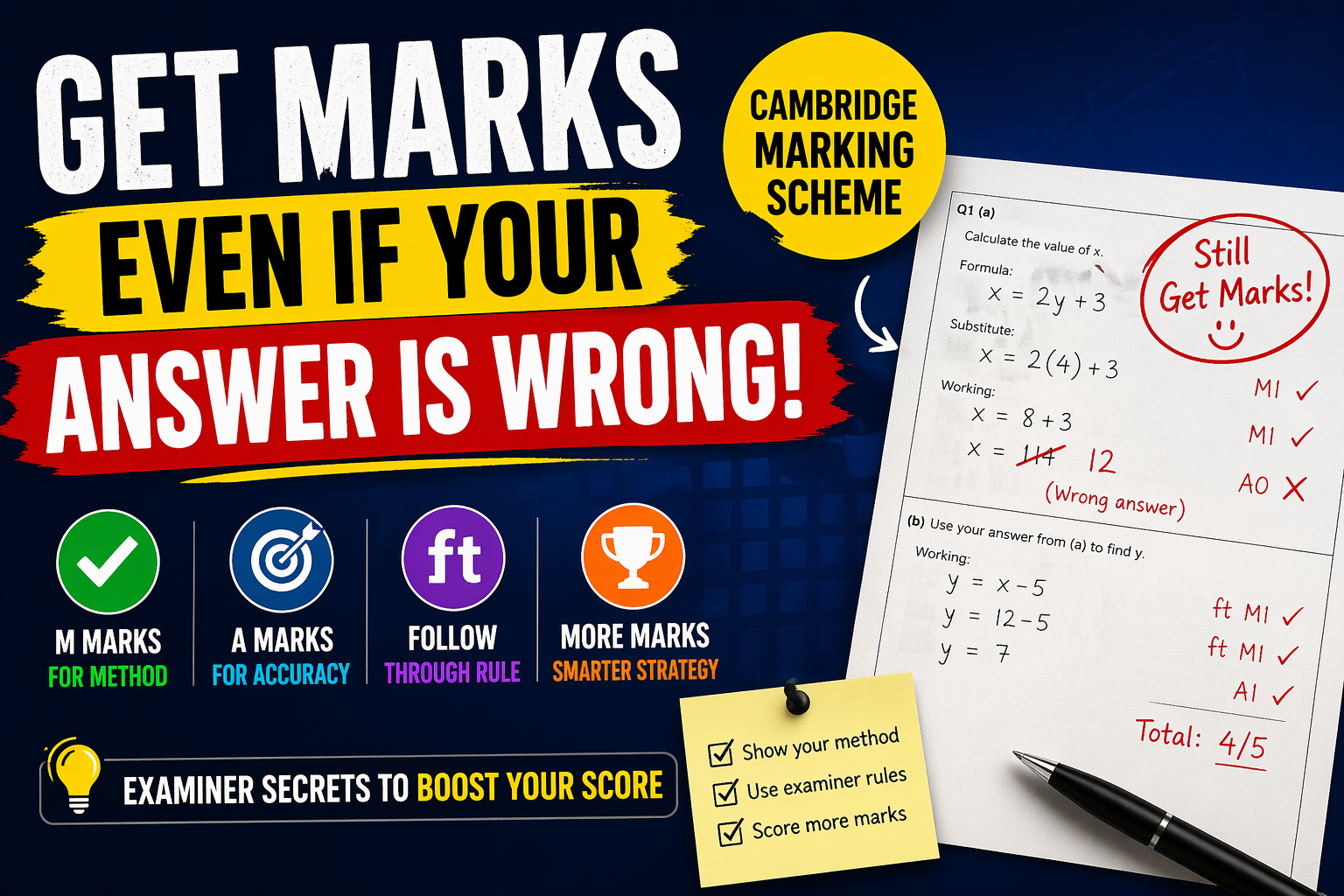
2. Cambridge Marking Scheme: M Marks vs A Marks Explained
Understanding this alone can increase your score instantly.
🔹 M Marks (Method Marks)
Awarded for:
- Using the correct formula
- Applying the correct method
- Showing correct steps
👉 You can still get M marks even if your answer is wrong.
🔹 A Marks (Accuracy Marks)
Awarded for:
- The correct final answer
👉 No correct answer = no A mark.
⚠️ The Golden Rule
A marks depend on M marks.
If your method isn’t visible, the examiner cannot award marks.
💡 Winning Strategy
Always:
- Write the formula first
- Substitute values clearly
- Show each step
Because:
- ❌ No working → M0 A0
- ✅ Clear method → M1 even if answer is wrong
3. Cambridge Marking Scheme: Understanding the Follow Through Rule (ft)
This is where most students lose easy marks.
What is ‘ft’ (Follow Through)?
It allows examiners to ignore your earlier mistake and still reward correct steps later.
Example:
Part (a) [2 marks]
- Correct formula ✔
- Calculation mistake ❌
👉 Score: 1/2 (M1 A0)
Part (b) [3 marks]
- Uses wrong value from (a)
- Applies correct method ✔
👉 Score: 3/3 (Full marks via ft rule)
Final Score: 4/5
👉 You recovered almost everything.
💡 Key Strategy
- Never leave a question blank
- If unsure, assume a value and continue
- Clearly label your steps
4. Cambridge Marking Scheme: How B Marks Help You Score Easily
‘B’ marks are the easiest marks to score.
Why?
They are:
- Independent
- Not linked to your method
- Not affected by previous mistakes
Common B Mark Opportunities
- Correct units (e.g. m/s², Ω)
- Accurate graph drawing
- Correct values in tables
- Proper labeling
💡 Smart Students Do This
They actively hunt B marks in every question.
5. Advanced Examiner Rules You Should Know
🔹 isw (Ignore Subsequent Working)
If you write the correct answer and then ruin it with extra steps:
👉 Examiner ignores the incorrect working and awards marks.
🔹 soi (Seen Or Implied)
Even if steps aren fully written but clearly implied:
👉 You may still earn marks.
💡 Takeaway
- Don’t overwrite correct answers
- Keep working clear and structured
6. The Exam Hall Checklist (Grade Saver)
Use this checklist during every Past Paper:
✔ Write the formula before solving
✔ Show every step (no mental math)
✔ Clearly label parts (a), (b), (c)
✔ Always include correct units
✔ Use correct significant figures
- Math: usually 3 s.f.
- Physics: 2–3 s.f. based on data
7. Final Insight: How Top Students Think
Top students don’t aim for perfect answers.
They aim to:
- Maximize marks per question
- Exploit examiner rules
- Avoid unnecessary mark loss
Your Answer Doesn’t Need to Be Perfect
Cambridge exams are not designed to fail you.
They are designed to reward:
- Your understanding
- Your method
- Your effort
A wrong answer is not failure — it’s a partial win.
If you apply these strategies correctly, you can:
Push your grade up significantly
Turn mistakes into marks
Recover lost scores