If you’re studying towards O Levels, IGCSE, or A Levels in Pakistan, there’s one document that will follow you into every university application: your IBCC equivalence certificate. It’s the bridge that converts your Cambridge grades into the local SSC/HSSC system that Pakistani universities use to calculate merit.
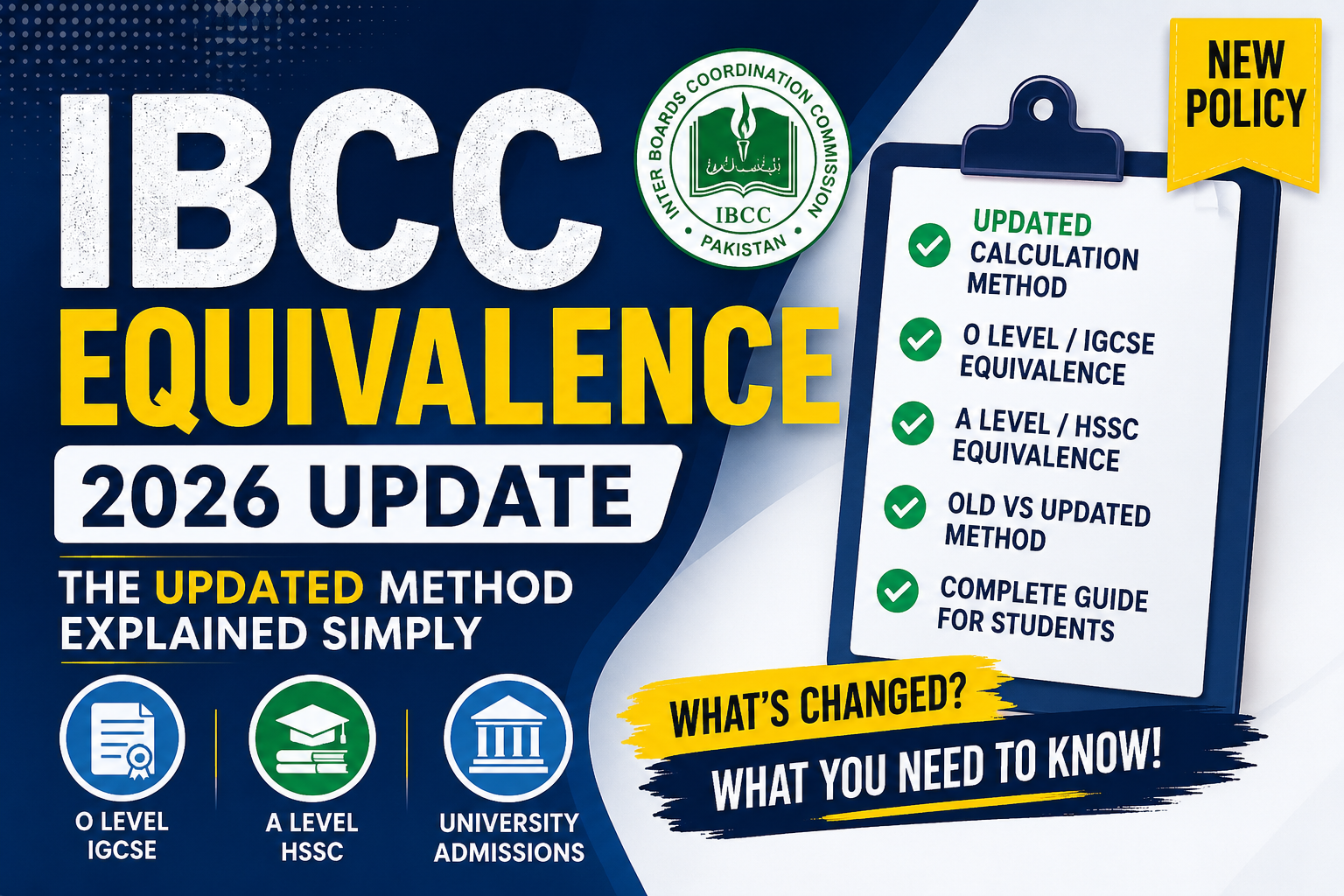
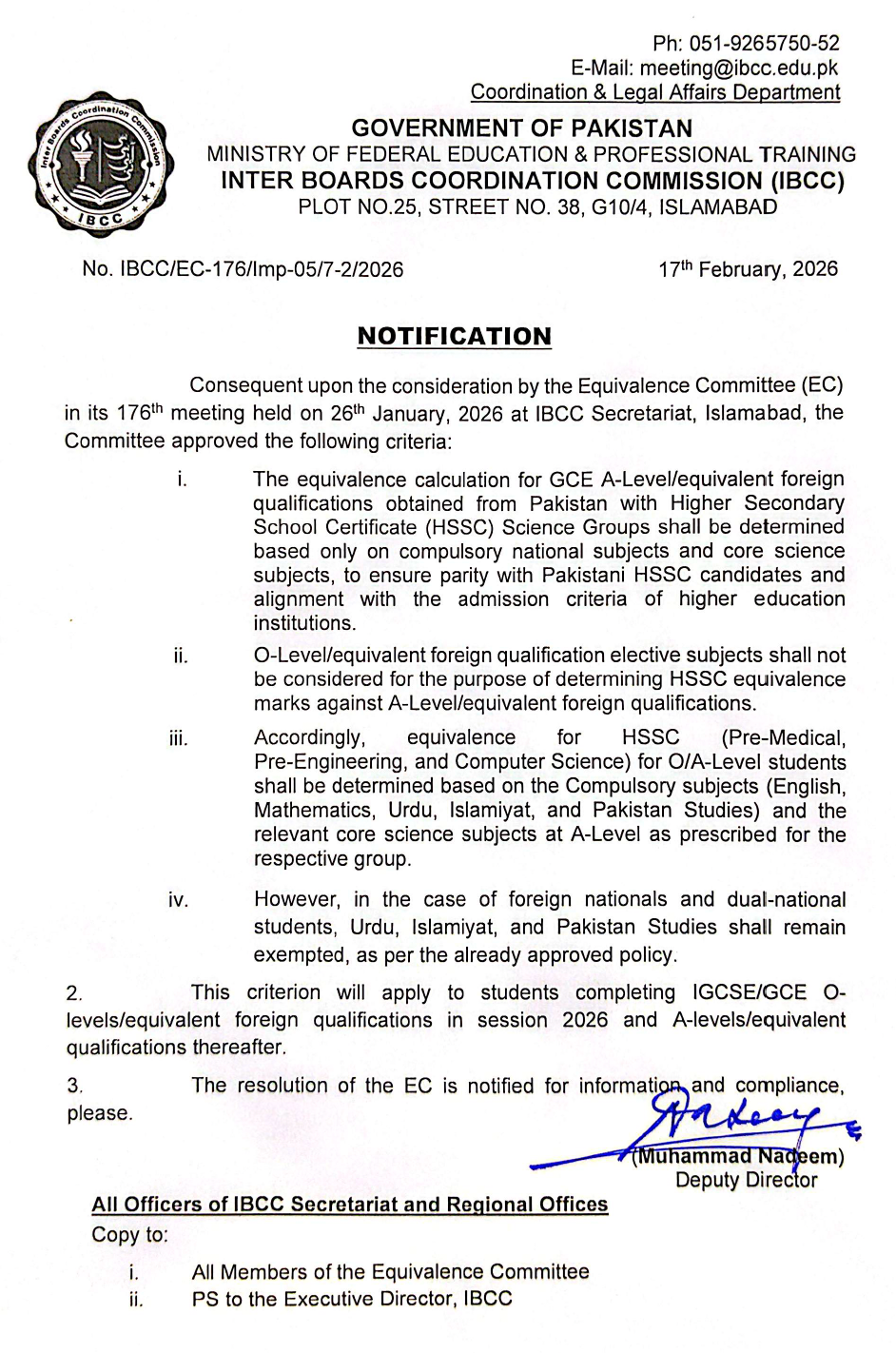
Starting with students appearing in exams from June 2026 onwards, the Inter Boards Coordination Commission (IBCC) is changing how that bridge is built — and the change has real consequences for how your final percentage is calculated. Here’s a breakdown of exactly what’s changing, what isn’t, and how to plan around it.
Why Is the IBCC Equivalence Formula Changing?ing the Formula?
The IBCC’s reasoning comes down to consistency. Elective subjects vary enormously from school to school, and the commission felt they weren’t giving a reliable picture of a student’s core academic strength. By narrowing the calculation to focus on core subjects only, the new method is meant to bring equivalence closer in spirit to how local HSSC Science students are assessed — and to make merit comparisons fairer across the board.
First, What’s Not Changing: O Level Requirements
Before getting into the A Level changes, it’s worth confirming that your O Level (SSC/Matric equivalence) requirements are staying exactly the same:
- Minimum 8 subjects must be passed.
- 5 compulsory subjects for students appearing from Pakistan: English, Mathematics, Urdu, Islamiyat, and Pakistan Studies. There’s no substituting these.
- 3 academic electives, chosen based on your intended stream.
- For Science Group equivalence, your electives must include Physics and Chemistry, plus one of Biology, Computer Science, IT, or ICT. If you’re eyeing Medicine, Biology isn’t optional here — skip it and you’ll land in the Arts Group instead.
- Grading threshold: A to E* grades are accepted. An F or G means denial of equivalence — full stop.
These 8 subjects remain the non-negotiable foundation of your O Level certificate. What’s changed is how much they matter once you move on to A Levels.
How IBCC Equivalence Is Calculated from June 2026
From June 2026, your A Level equivalence percentage will be calculated using only 8 subjects:
- Your 5 compulsory O Level subjects
- Your 3 A Level subjects
Your 3 O Level elective subjects are excluded entirely from this calculation. Under the old system, these three grades acted as a buffer — a chance to pull up your average with strong elective performance. From 2026 onwards, that buffer disappears completely from the maths.
“Excluded” Doesn’t Mean “Optional”
This is the part students most often get wrong. Even though your O Level electives no longer count towards your A Level percentage, you still must pass all three to receive your O Level certificate in the first place. And since your O Level certificate is a prerequisite for A Level equivalence, failing or skipping an elective doesn’t just cost you those marks — it breaks the entire equivalence chain.
IBCC Equivalence: Old vs. New Method
| Feature | Old Method (Pre-June 2026) | Updated Method (June 2026 Onwards) |
|---|---|---|
| Subjects counted | 5 Compulsory O Level + 3 Elective O Level + 3 A Level | 5 Compulsory O Level + 3 A Level |
| O Level electives | Included in marks calculation | Excluded from marks calculation |
| Total subjects used | 11 | 8 |
A Level Subject Combinations Still Matter
The calculation method has changed, but the subject combinations required for specific career paths haven’t:
- Pre-Medical: Physics + Chemistry + Biology
- Pre-Engineering: Math + Physics + Chemistry, or Math + Physics + Computer Science
- Computer Science / General: Math + any 2 academic subjects
- Humanities: Any 3 academic subjects
Worth noting: a Grade E technically satisfies IBCC’s minimum requirement, but in Pakistan’s merit-list culture — where admissions are often decided to the third decimal point — an E can quietly rule you out of competitive medical and engineering seats.
What This Actually Means for Your Study Strategy
This isn’t just an administrative tweak — it changes where your effort should go.
- Every subject now carries more weight. Dropping from 11 counted subjects to 8 means each grade has a bigger share of your final merit percentage.
- Compulsory subjects are now high-stakes. In the old system, a weak grade in Urdu or Pakistan Studies could be diluted by three strong O Level elective grades. That cushion is gone. A “C” in Urdu will hit a Pre-Med student’s merit much harder than it used to.
- Don’t slack on electives just because they’re excluded from HSSC calculation. They’re still mandatory to pass. Treating them as low-priority is a common — and costly — mistake.
- Consistency beats volume. The new formula rewards students who perform steadily across their compulsories and A Levels, rather than those who used a wide subject load to boost their average.
The Bottom Line
From June 2026, IBCC will calculate your A Level equivalence using just 8 subjects — your 5 compulsory O Levels and your 3 A Levels. Your O Level electives remain compulsory to pass, but they no longer factor into your final HSSC percentage. If you’re planning your subject strategy for the years ahead, this is the moment to start taking your compulsory subjects — and your A Level grades — more seriously than ever.