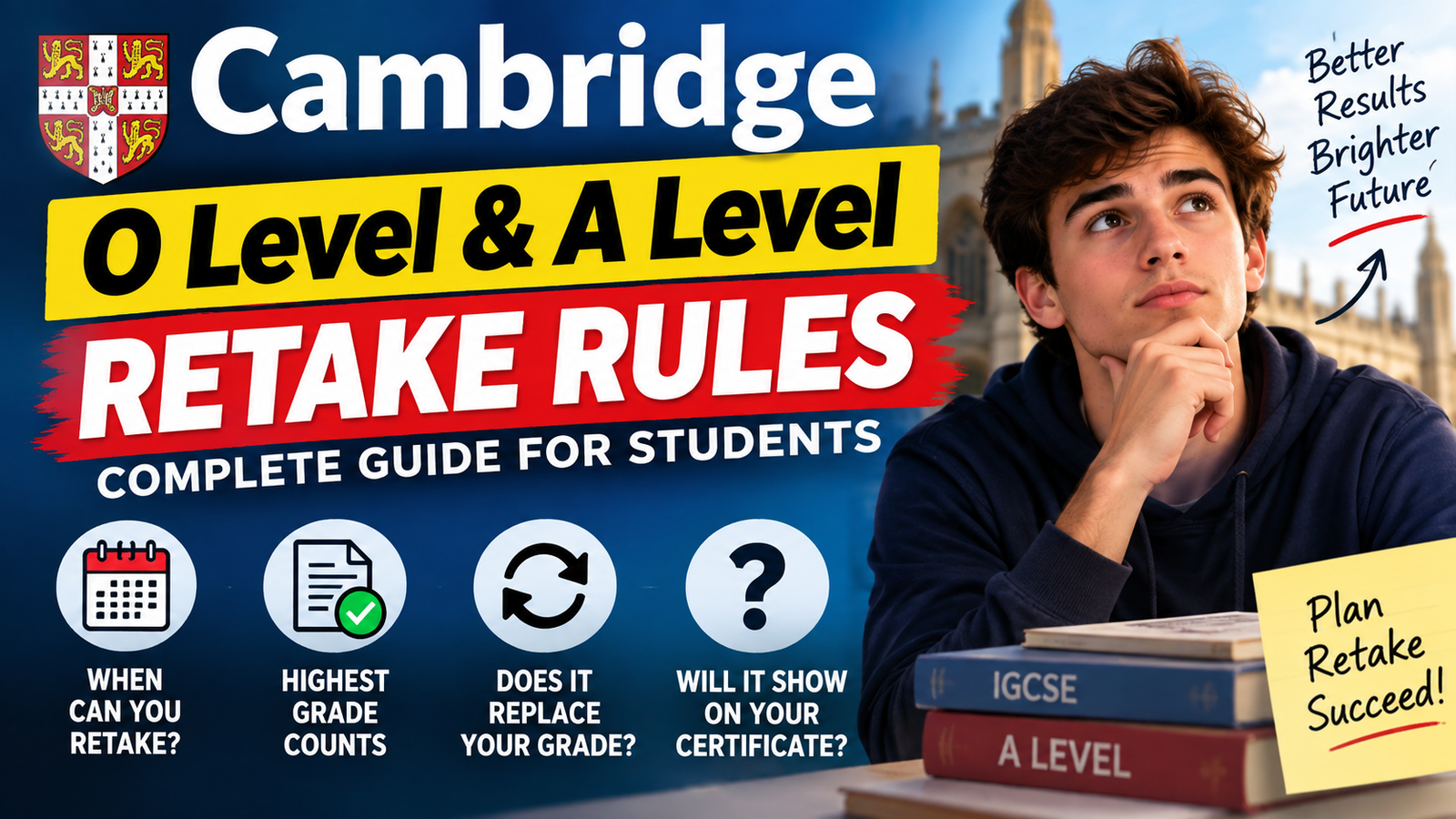
1. What Is a Cambridge Retake?
In the rigorous world of Cambridge International qualifications, a “retake” (or resit) is more than just a second chance; it is a strategic maneuver intended to align your academic profile with your university ambitions. However, precision in definition is vital. Within the Cambridge framework, an entry is officially classified as a retake only if the candidate sits the same syllabus within one year of their previous attempt.
From a strategic standpoint, recognizing the “Retake” status is the difference between a cost-effective recovery and a financial burden. Cambridge provides a specific, narrow registration window for candidates who sat the same syllabus in the immediately preceding session. As an advisor, I must emphasize that missing this window—often occurring shortly after results are released—forfeits your “Retake” status, potentially subjecting you to late entry fees that can double or triple the standard cost. While the O Level and IGCSE pathways are relatively straightforward, the A Level retake process introduces a “Linear” complexity that requires deeper planning.
2. Can You Retake a Cambridge O Level or IGCSE?
Absolutely. Cambridge O Level and IGCSE examinations are highly accessible for resits, serving as a vital mechanism for students to solidify their foundational credentials. However, you must approach these with the understanding that they are “Linear” qualifications.
- Retake Allowance: You may resit any syllabus in the next available series (typically October/November for June candidates).
- Linear Nature: Unlike modular systems where you might retake a single unit, a Cambridge O Level retake is a “high-stakes reset.” You are generally required to sit all written components of the syllabus again to generate a new result.
- Attempt Limits: There is no official limit on the number of attempts permitted, provided the syllabus remains active and available.
Strategic Advisor Note: While the “no limit” rule offers a safety net, remember that a linear retake is a total reset of your workload. You must be prepared to re-master every paper in the syllabus, not just the one where you underperformed.
3. Can You Retake a Cambridge International A Level?
Retaking a Cambridge International A Level is a sophisticated administrative and academic undertaking. Because these results are the primary currency for university placement, the rules regarding record-linking are uncompromising.
For Cambridge International A Levels, retakes are available in the June and October/November series only. Note that while other boards (like Pearson Edexcel or OxfordAQA) may offer January sessions, Cambridge does not. To ensure your “Highest Grade Counts” safety net remains active, you must provide your previous centre and candidate numbers during registration via the School Registration System (SRS) portal. This links your academic history into a unified record.
Because Cambridge A Levels are linear, you cannot simply “patch” a weak result in one paper. You must typically sit all written components for the syllabus in a single series. This requires a significant commitment to comprehensive revision rather than targeted unit-cramming.
4. What Happens If Your Retake Grade Is Lower?
The most common psychological barrier to retaking is the fear of “ruining” a mediocre but acceptable grade. However, the Cambridge framework is designed to reward ambition, not punish it.
The “Highest Grade Counts” Rule: Cambridge operates on a protective policy where your highest achieved grade is the one that remains valid for your qualification. Consider this scenario:
- First Attempt (June): Grade C
- Retake Attempt (Nov): Grade D
- Final Result: Your Grade C stands as your official qualification grade.
This rule provides a strategic floor, allowing you to aim for an ‘A’ without the risk of being left with a ‘D’ should the second attempt go poorly.
5. Does a Cambridge Retake Replace Your Old Grade?
It is a common myth that a new grade “erases” the old one. In reality, Cambridge does not delete your history; it manages it through supersedence.
- No Erasure: Your previous result remains a permanent part of the Cambridge database.
- Superseding for Entry: While the old grade isn’t “replaced” in the sense of being deleted, it is superseded by a higher retake grade for the purpose of meeting university requirements.
- Unified Records: By using your previous candidate details in the SRS portal, you ensure the board recognizes both attempts as belonging to one student, allowing the “highest grade” logic to be applied automatically to your transcript.
6. Will Your Retake Show on Your Cambridge Certificate?
Transparency is fundamental to the integrity of International Qualifications. Because every certificate is tied to a specific “exam series” (e.g., June 2024 vs. Nov 2024), your retake will result in the issuance of a brand-new certificate for that specific session.
Your previous attempt will not be printed on your new certificate. However, it still exists on the certificate from the original series. In practice, this means you may possess two different physical documents. When applying to institutions, you will present the certificate that showcases your best performance. Be aware, however, that the “exam series” printed on the certificate clearly indicates to any admissions officer when the exam was taken, making the retake status evident.
7. Can You Retake Only One A Level Component?
Due to Cambridge’s linear exam philosophy, the standard answer is no. You cannot pick and choose individual papers to retake in isolation to form a new grade.
- Linear Philosophy: Cambridge views the syllabus as a holistic assessment. Therefore, you must generally retake all written components of the syllabus in one go.
- Syllabus Exceptions: You must check your specific syllabus and entry options via the SRS portal, as the “all-at-once” rule is the baseline for Cambridge International.
- The Carry-Forward Exception: The only way to avoid retaking every single paper is by using the 13-month carry-forward rule, which allows you to bring AS marks into a full A Level entry.
8. What Is the Cambridge 13-Month Carry-Forward Rule?
The 13-month carry-forward rule is the most powerful strategic tool for A Level students. It allows you to reuse marks from your AS Level (the first half of the A Level) toward a full A Level result in a later session, effectively skipping the need to sit the AS papers again.
The rule is strictly “use it or lose it.” You must have sat the original AS exam within the past year (the 13 months includes a one-month administrative buffer). For example, a mark earned in June 2024 can be carried forward to the October/November 2024 series or the June 2025 series. If you wait 14 months, those marks expire, and you are forced into a full linear retake of all components (AS + A2).
9. Can You Carry Forward AS Level Marks?
Carrying forward marks is the primary path for students transitioning from AS to A2 without redundant testing. To execute this correctly:
- Timing: Ensure you are within the 13-month window from your last attempt.
- Registration Data: You must provide your previous centre and candidate numbers. Without these, the British Council cannot link your old AS marks to your new A2 entry.
- Syllabus Match: Your entry option must specifically be a “carry-forward” option (e.g., Option Code A, B, or C depending on the syllabus).
10. Do Universities Accept Cambridge Retakes?
This is the most critical distinction a student must understand: Cambridge grants you permission to sit a retake, but a university decides whether to accept it.
While Cambridge’s internal policy is “Highest Grade Counts,” this holds no authority over university admissions offices. Many competitive institutions (particularly for Medicine, Law, or Ivy League/Russell Group entries) have a “first sitting only” preference. They may penalize retakes or raise the entry requirement for students who did not achieve the grade on their first attempt. Always verify the specific resit policy of your target university before committing the time and fees to a retake.
11. What Should You Check Before Retaking?
Missing a technical detail can result in a “Double or Triple” fee penalty for late entry. Before registering, perform this pre-registration audit:
- Target vs. Current: Is the potential grade jump large enough to justify the effort and cost?
- Series Availability: Confirm the subject is offered in the upcoming June or Nov series (Cambridge does not offer January sessions).
- Component Codes: Ensure you are registering for the correct syllabus and entry option.
- Carry-Forward Eligibility: Are you within the 13-month window?
- SRS Identity: Are you using your previous login and candidate details to link your history?
- University Policy: Have you confirmed your target school accepts retakes for your specific course?
12. Cambridge Retake Rules — Quick Summary
The Cambridge retake system offers a robust “Highest Grade Counts” safety net and the strategic flexibility of the 13-month rule. To succeed, you must manage your registration via the School Registration System (SRS) portal with absolute precision. By ensuring your previous candidate numbers are used, you protect your academic history and ensure that your best performance is the one that defines your future.
FAQ Section
1. Can I retake Cambridge O Levels? Yes. You can resit O Levels in any available series. Since they are linear, you will typically need to retake all written components of the syllabus to get a new grade.
2. Can I retake Cambridge A Levels? Yes. You can retake A Levels to improve your score. You must provide your previous centre and candidate numbers during registration to link your results.
3. What happens if I get a worse grade in my retake? Cambridge’s “highest grade counts” policy ensures your better grade remains valid. If you get a ‘D’ on a retake after previously getting a ‘C’, the ‘C’ remains your official result.
4. Does my old Cambridge grade disappear? No. Your previous results remain in the board’s permanent records. However, only the highest grade counts toward your final qualification.
5. Does a retake replace my previous grade? No. It does not delete the old grade. Instead, it generates a new result which supersedes the old one for university applications if the new grade is higher.
6. Can I retake individual A Level components? Generally, no. Cambridge is a linear system, meaning you must sit all written papers again. The only exception is carrying forward AS marks within the 13-month window.
7. Can I carry forward my AS Level marks? Yes, provided you sat the AS exam within the last 13 months. This allows you to combine those marks with your A2 papers to finish your full A Level.
8. What is the 13-month rule? It is the time limit for carrying forward AS marks. You must use your AS marks toward a full A Level within 13 months of the original session, or they will expire.
9. Will universities know I retook an exam? Yes. Universities usually require a full transcript or multiple certificates, which will show the different exam series (dates) for your attempts.
10. Do universities accept Cambridge retakes? Most do, but elite universities may have stricter policies. You must check with the admissions office of your target institution to see if they prefer “first sitting” results.